Tag: Property Accounting

  • Five Property Accounting Red Flags That Distort Financials

    Five Property Accounting Red Flags That Distort Financials

    When property financial reports do not reflect a property’s actual performance, the problem often lies in how transactions are recorded. If cash balances seem unusually low, liabilities continue to grow, or Net Operating Income (NOI) fluctuates dramatically from month to month, accounting errors may be masking the true financial picture.

    Many of these issues stem from common real estate bookkeeping mistakes that go unnoticed for months or even years. When bookkeeping and accounting records are inaccurate, property owners, investors, and property managers may make important decisions based on misleading financial information.

    Identifying these problems early can improve financial reporting, provide a clearer picture of property performance, and help owners make more informed investment decisions.

    Fortunately, several common warning signs can help identify the source of these issues. Here are five property accounting red flags every property owner and manager should watch for and the steps needed to correct them.

    Red Flag #1: The Rent Roll Doesn’t Match Gross Potential Rent

    The rent roll and Gross Potential Rent on the Income Statement should generally align. While legitimate timing differences can occur, improperly recorded rent escalations, concessions, and abatements are among the most common causes of discrepancies.

    For example, a tenant may receive a rent concession under the terms of a lease, but if the accounting software is not configured to recognize that concession correctly, the rent roll and income statement will tell two different stories.

    This mismatch can artificially inflate or suppress revenue, making it difficult for owners, lenders, and potential buyers to evaluate occupancy levels, rent collections, and overall property performance.

    How to fix it: Reconcile the rent roll to rental revenue each month. Record concessions, abatements, and vacancies in dedicated contra-revenue accounts to ensure financial statements accurately reflect contractual rent and actual collections.

    Red Flag #2: Security Deposits Are Being Used for Operating Expenses

    In residential property management, tenant security deposits should be maintained separately from operating funds. Accounting records should support a complete reconciliation between:

    • The security deposit register
    • The security deposit bank account
    • The security deposit liability account

    For commercial and retail properties, the tenant deposit schedule should reconcile directly to the liability account in the general ledger.

    When these records do not match, audit concerns arise, working capital calculations become unreliable, and tenant funds may be improperly commingled with operating cash.

    How to fix it: Perform a monthly reconciliation of tenant deposit records, trust accounts, and liability balances. This ensures that security deposits are accurately reported and properly safeguarded.

    Red Flag #3: The Entire Mortgage Payment Is Recorded as an Expense

    Another common mistake is recording the entire mortgage payment as an expense instead of allocating it correctly between principal, interest, and lender escrow accounts.

    When this occurs, operating expenses are overstated, taxable income may be misstated, and the loan balance on the balance sheet drifts away from the lender’s actual amortization schedule.

    How to fix it: Reconcile the loan balance to the lender’s monthly statement. Record interest as an expense, reduce the loan principal accordingly, and classify lender held tax and insurance escrows as assets. This approach keeps both the income statement and balance sheet accurate.

    Red Flag #4: Unreconciled Accrued Liabilities Remain on the Balance Sheet

    Accruing expenses such as utilities, landscaping, and property taxes is a standard accounting practice. Problems arise when the accrued liability is not reversed after the actual invoice is received and posted.

    In many cases, the invoice gets charged directly to expense while the original accrual remains on the books. As a result, the same expense is effectively recorded twice, reducing reported net income and leaving stale liabilities on the balance sheet indefinitely.

    How to fix it: Reconcile accrued liability accounts every month. Investigate any old balances, reverse accruals that are no longer needed, and follow up with vendors when expected invoices have not been received. Regular review prevents duplicate expenses and ensures liabilities remain accurate.

    Red Flag #5: Capital Improvements Are Recorded as Repairs and Maintenance

    Major expenditures such as roof replacements, asphalt repaving projects, and HVAC system upgrades generally provide benefits that extend beyond the current year. These types of costs should often be capitalized and depreciated rather than expensed immediately.

    When significant improvements are incorrectly charged to Repairs and Maintenance expense, NOI is understated, property valuations may appear lower than they should, and tax reporting can become inaccurate.

    How to fix it: Establish and consistently follow a capitalization policy. Significant improvements that extend a property’s useful life or increase its value should be recorded as fixed assets and depreciated over the appropriate recovery period.

    Accurate Financials Drive Better Decisions

    Property owners, lenders, and investors rely on accurate financial statements to assess performance and make informed decisions. When financials are distorted by unreconciled accruals, commingled deposits, improperly recorded debt payments, or miscoded capital expenditures, the resulting reports can lead to costly mistakes.

    For more than 25 years, I have helped property owners and management companies untangle complex accounting issues, reconcile inaccurate records, and produce financial statements that stand up to lender, investor, and audit scrutiny.

    If you would like a comprehensive review of your property’s financial records, contact me today to schedule a consultation.

  • Real Estate Portfolio Bank Loans: What Underwriters Look For

    Real Estate Portfolio Bank Loans: What Underwriters Look For

    When applying for a commercial real estate loan, portfolio blanket mortgage, or acquisition line of credit, the condition of your financial package carries just as much weight as the quality of your physical properties.

    Commercial loan officers and credit committees review dozens of borrower packages every week. When a file arrives containing unadjusted reports exported directly from third party property management software, it creates immediate questions about financial control and actual asset performance. Even high occupancy properties with significant cash flow face extended underwriting delays, higher interest spreads, or loan denials when financial schedules do not reconcile.

    Securing favorable commercial terms requires reporting from beyond automated software. Understanding how underwriters evaluate income producing properties and portfolio risk is essential to presenting a clean, bank ready package.

    Why Real Estate Portfolio Underwriting Is Unique

    Commercial lenders do not underwrite rental real estate like a standard operating business. Credit analysts focus on specific cash flow metrics and asset-level accounting controls such as true Net Operating Income (NOI). Lenders verify that income reflects collected revenue net of physical vacancy, bad debt, and tenant concessions. Lenders also check for capital improvements (CapEx) categorized as routing maintenance. When major roof replacements, parking lot repaving, or complete HVAC overhauls are recorded in routine repair categories, your NOI is not reflected accurately. This can make a performing property appear unable to cover required debt service. 

    Red Flags That Trigger Underwriting Delays

    Lenders look for discrepancies between your operational data and your historical financial statements. Common issues that stall credit approval include:

    • Rent Rolls That Do Not Tie to the Operating Statement: If your rent roll indicates $25,000 in monthly contractual rent, but your operating statement shows $19,000 without a clear explanation of vacancy or bad debt write-offs, the underwriter will pause the file.
    • Tenant Security Deposits Treated as Operating Cash: Commingling tenant trust funds with property operating cash distorts actual liquidity and creates balance sheet discrepancies during cash verification.
    • Uncapitalized Improvements Distorting Debt-Service Coverage (DSCR): Lenders require a minimum Debt-Service Coverage Ratio—typically 1.20x to 1.35x. If $40,000 in structural capital improvements is reported as routine repairs on the P&L, your NOI drops, causing the property to artificially fail the bank’s DSCR requirement.
    • Inconsistent SREO Balances: If the debt service or loan balances on your Schedule of Real Estate Owned (SREO) do not match the liabilities listed on your tax returns or credit reports, underwriters will require formal explanations and updated amortization schedules.

    How CPA Prepared Reports Accelerate Loan Approvals

    Submitting financial statements that have been reviewed and structured according to standard accounting standards significantly reduces underwriting turnaround times. Balance sheets, cash flow statements, and operating schedules need to be presented with consistent accounting methodologies, preventing confusing reconciliation questions. Adding notes that detail debt terms, partner equity splits, and capital expenditure amortization provides underwriters with answers before formal inquiries are raised. When financial reports, SREOs, and tax filings match down to the dollar, credit officers can present the loan package to the credit committee with confidence, avoiding back-and-forth documentation requests.

    Preparing Before You Apply

    The best time to prepare your portfolio for commercial financing is 30 to 60 days before submitting your loan application. Taking the time to audit tenant deposit accounts, capitalize major property improvements, and reconcile the Schedule of Real Estate Owned against your balance sheets ensures you maintain control of your financing timeline and secure the best available terms.

    Andris Financial Services is a CPA firm with over 20 years of experience preparing financial reports for real estate investors and property management companies.  No matter where you are in the process of securing a loan, my firm can help you present lender ready financial packages to underwriters.  Select an option below to begin the process.

    Prefer to send a confidential message? Submit your inquiry below.

    Name
  • Is Your Property Management Accounting Putting Your Texas Portfolio at Risk?

    Is Your Property Management Accounting Putting Your Texas Portfolio at Risk?

    Questions Regarding Rent and Security Deposits

    Is your property manager collecting all potential rent from your tenants?  Do you run into cash flow issues when it is time to refund a security deposit?  These are known issues for real estate portfolios utilizing property management companies for accounting.  Whether your portfolio includes commercial, multifamily, or single-family residential properties, collecting rent every month and recording security deposits correctly keeps the property from falling into a cash flow shortage. The state of Texas also has strict rules regarding security deposits.  I will detail how to avoid these pitfalls for rent and security deposits and how property managers should perform the monthly review.

    Review the Rent Roll and Profit & Loss Statement

    The rent roll report lists all tenants and monthly rent amounts.  It shows the rent amounts due every month.  It also includes the rent increases or escalations for upcoming renewals.   If your property manager has abstracted the leases and set up each tenant’s lease correctly in the property accounting software, the rent roll summarizes all lease rental terms in one document.  If your real estate portfolio has not scaled to enterprise property management software, the rent roll has to be documents in some other format.

    Once the rent roll is set up, the amounts on the rent roll must be compared to the revenue amounts on the Income Statement.  The revenue items vary based on each real estate portfolio type.  All have rent but for example commercial real estate also includes recoveries for CAM, property tax, and insurance.  If the monthly rent revenue general ledger account does not match the rent roll, any discrepancies must be noted by the property manager on the variance report.  Valid reasons for the differences include the following:

    • prorated rent for a new tenant
    • prior period charges billed in the current month (these must be approved by the owner)
    • rental concessions (the proper accounting is a separate general ledger account). 

    Any other discrepancies must be addressed by making sure the lease abstract is correct or checking the accounting system to determine whether the lease was entered correctly.

    Security Deposits vs Bank Statement

    In the state of Texas, security deposits are required to be kept in a separate bank account.  The property manager has to perform a three-way matching to reconcile the security deposits balances are correct.  Below are the three documents and reports the property manager should review every month.

    • Security deposit bank statement
    • General ledger account for security deposits
    • Rent roll/lease deposit report

    As discussed previously, the rent roll is the report created after the leases are abstracted.  Security deposits are reflected on the rent roll.  When the property manager records the actual security deposit paid by tenants, these are recorded in the security deposit general ledger account.  The actual cash is then deposited in the bank account.  When these accounts do not match up, it is usually because of the following reasons:

    • The security deposit was not physically deposited in the correct bank account.
      • In this case, the funds are comingled and creates a bigger problem.  Now security deposits are being used to pay operating expenses. Tenant leases have strict deadlines for the refund of deposits and if the deposit funds are used for other purposes, the tenant can potentially take legal action.
    • Sometimes the difference is just a timing issue.  If a tenant moves out at the very end of the month, the lease deposit report will show an expired lease but the security deposit balance on the general ledger and bank statement will still show a lease because the move out refund is still in process.
    • Another timing issue is when the tenant wires or pays the security deposit by ACH at the very end of the month prior to the lease starting.  In this instance, the bank shows a deposit, but the rent roll and general ledger do not have anything recorded.

    These timing differences should be explained in the financial reports provided by the property manager and need to be cleared up before the next report is issued.  The security deposit into the incorrect bank account is a sign of an internal control issue and should be watched to determine if your property manager is handling your cash properly.

    Need More Information?

    My monthly review includes identifying these discrepancies. Your rent needs to be collected according to the lease and the reports need to be presented correctly for current investors, future owners, and lenders.  If you would like to discuss any of the items above for your portfolio or have any questions regarding your Texas property management accounting, schedule a consultation below. 

  • How Incomplete Real Estate Accounting Stalls Your Texas LLC Commercial Loan Closing

    How Incomplete Real Estate Accounting Stalls Your Texas LLC Commercial Loan Closing

    The Texas Real Estate Market and Financial Reports

    Are you in the process of applying for a Texas real estate loan?  Is your lender questioning your financial records?  You do not have to figure this out on your own.  Consulting with a Texas CPA who understands real estate accounting is the best option to get through the loan closing process.  The Texas real estate market is strong with industrial and multi-family showing stable growth, while office and retail are being reviewed by lenders with a very detailed eye.  This means the bookkeeping and accounting for the financials, rent rolls, and operating assumptions of your Texas real estate LLC must be clean, realistic, and defensible.  Given this information, it is important to have strong internal controls and accurate, detailed reporting for your real estate portfolio.   I will delve into the lender financial requirements with a focus on Texas real estate accounting for underwriting.

    Which Financial Reports Does the Lender Need?

    The standard underwriting documents required for commercial real estate loan qualifications are the following:

    • Business tax returns – 2 – 3 years
    • Monthly bank statements – last 3 – 6 months
    • Personal Financial Statements
    • Balance Sheet for business
    • Profit & Loss for business – Year to date
    • Historical P&L statements for the property – last two years
    • Current rent roll

    Debt Service Coverage Ratio (DSCR)

    The lender will review all required financial documents to determine if the real estate LLC is able to cover the loan payments.  This is called debt service coverage ratio.  They will not be able to determine the ratio if incomplete or inaccurate financial statements and reports are submitted which result in a stalled loan closing process.

    Internal Controls for Your Texas Real Estate Accounting & Portfolio

    The initial setup of your real estate LLC portfolio and ongoing internal controls set the tone for how lenders and underwriters view your qualifications.  Whether you are using QuickBooks, Yardi, AppFolio, or do not have a complete set of financial reports, each real estate LLC must have its own separate entity in the accounting software.  It is tempting to lump all rental payments into one account due to the bank fees associated with multiple bank accounts but proper multi-entity real estate accounting dictates that each entity must have a separate identification. Commingling funds can also put the LLC liability protection at risk.

    How Do Lenders Compare Tax Returns to Submitted Financial Reports?

    The lender will look at the tax returns because these are the official documents filed with the federal government.  The review entails revenue, expenses, income, and assets reported to the IRS for the LLC loan applicant and those items are then compared to the financial reports such as the Profit & Loss Statement and Balance Sheet.  This is where the real estate bookkeeping can derail the loan closing.  If your tax returns vary wildly from the financial reports pulled from your accounting software, this is a red flag for the underwriter.   It makes your financial reporting seem unreliable, which discredits your ability to make payments on time.

    Why Is a Rent Roll Required for a Loan Application?

     If rental payments for multiple real estate LLC’s are recording in QuickBooks, Yardi, or on the bank statement under one entity, the underwriter is not able to verify the credibility and cash flow of the real estate LLC.  Unfortunately, this bookkeeping process will delay the closing. When an underwriter reviews the rent roll and P&L statement, the rental income must match.  The P&L tells the underwriter how much rent the LLC is collecting.  If the rent roll has different rent amounts, the underwriter cannot accurately determine the future rents and the ability of the LLC to make the loan payments.

    Unrecorded Liabilities Masks Ability to Pay

    The bank statements are reviewed for monthly incoming and outgoing payments.  If recurring payments to a financial institution are on the bank statement, the lender will question the source of these payments. If the bookkeeper did not record the loan on the financial statements or the loans are not on the debt schedule, the DSCR cannot be determined.  The balance sheet needs to show all liabilities including commercial mortgage loans, escrow payments, and notes payable.

    How to Prevent a Delayed Texas Real Estate Loan Process

    As a professional CPA licensed in the state of Texas, I review the same documents the lender reviews as part of my standard financial reporting process. Whether you need a set of reports created from scratch or the lender requires CPA prepared or reviewed financial reports, I am licensed and certified to handle this lender requirement for your Texas real estate portfolio.

    If you have need to register your foreign real estate LLC in Texas or get your Texas LLC back in good standing, contact me and I will handle your Texas real estate portfolios with the diligence of seasoned real estate professional!

  • A Simple Step-by-Step CAM Reconciliation Example

    A Simple Step-by-Step CAM Reconciliation Example

    The Basics of CAM Reconcilations

    For Texas retail and commercial property owners, the CAM reconciliation is the process to collect each tenant’s share of expenses for the prior year.  This calculation must be correct because of two reasons.  Number one is the relationship between the landlord and tenant.  Sending a tenant an invoice for undercharged expenses creates questions from tenants regarding how the property owner is calculating expenses.  The second reason the CAM reconciliation has to be correct is because of the owner’s responsibility for expenses.  If every expense is not accounted for on the reconciliation, it is difficult to go back to the tenants and ask them to pay for an unexpected expense. 

    The accounting for CAM reconciliations does not need to be a headache for property owners if done correctly.  I will walk through a simple triple-net (NNN) lease for retail and commercial properties so that you will feel confident when it is time to bill tenants for their lease recoveries. 

    Please note: this calculation is for a standard, pure triple-net (NNN) lease which is typical for local retail strips centers and simple commercial properties. If your building utilizes complex office leases with base years, expense stops, and cumulative caps, your reconciliation requires a customized lease by lease calculation.

    Gather the Baseline CAM Reconciliation Data

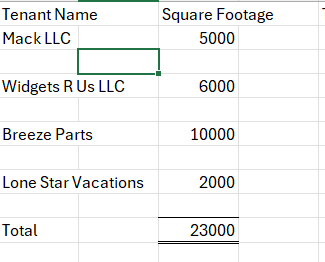
    Before we start the calculation, we must have two items: the total square footage of the building (gross leasable area) and each suite’s square footage. 

    The gross leasable area (GLA) is the total square footage of the building that can actually be rented out to tenants.  This square footage will be the denominator for the entire property.

    There should also be a master list of the exact square footage occupied by each individual tenant as defined in their specific lease agreements.  Where this information is kept depends on several factors but this can be stored on a spreadsheet or in the property management software.

    Exhibit A

    Note: CAM expenses generally cannot be charged to tenants for vacant spaces.  The landlord must absorb the vacant space share of costs unless there is a specific gross up clause.

    Calculate the Tenant Pro-Rata Share Based on Square Footage

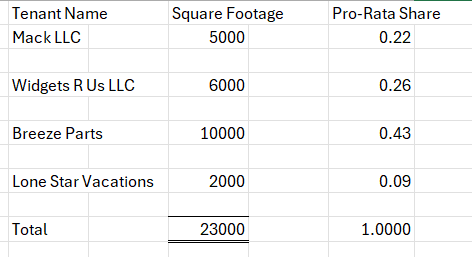
    To determine how much of the annual expenses is each tenant’s responsibility, the pro-rata percentage needs to be calculated.

    The formula is Pro-rata % = Tenant suite square footage / Total building square footage

    Using the information from above, we get the following pro-rata shares

    .

    Exhibit B

    Calculate The Tenant Share of Recoverable Expenses

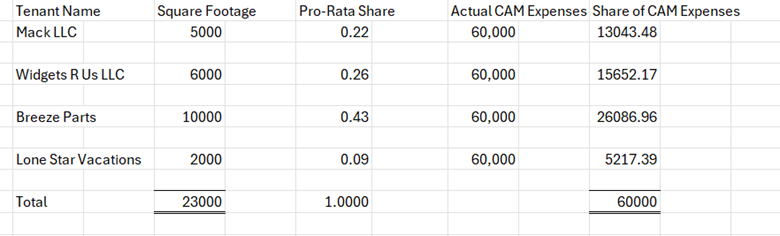
    The formula for the tenant share of expenses is Pro-rata share of expenses = Actual CAM Expenses X Pro-Rata Share Percentage.  For this example, the total CAM expense are $60,000.00.    Each tenant’s share is calculated below in Exhibit C.

    The same calculation is required for taxes and insurance. It is important to make sure taxes are correct given the amount of Texas property tax protests and adjustments. 

    Pro-Rata Share of Taxes = Pro-Rata Percentage X Tax Expense

    Pro-Rate Share of Insurance = Pro-Rate Percentage X Insurance Expense

    Note: If a tenant did not occupy a suite or space for the full 365 days, the expenses will need to be prorated according to the number of days the tenant occupied the suite.

    Calculate the Amount Due From or Credit Due to Each Tenant

    The next step is to calculate the amount due from each tenant if the estimated expenses were underbilled.  If the expenses were overestimated, the tenant is owed a credit.

    Property management software such as Yardi, MRI, or AppFolio have tenant reports to determine how much each tenant was charged per month for CAM, tax, and insurance.  If this information is kept in another form, you can still calculate the amount charged.  Determine the charges for the past year and deduct the expense for each NNN bucket (CAM, tax, insurance). For example:

    Mack LLC was charged $12,000 for the prior year CAM expenses.  Their calculated pro-rata share of actual CAM expenses was $13,043.48 per Exhibit C.  Mack LLC owes $1,043.48 to the property for the prior year expenses.

    Let’s assume Breeze Parts was charged $27,500.00 for prior year expenses.  Per Exhibit C above, the tenant overpaid CAM expenses ($26,086.96) for the prior year and is owed a credit of ($1,413.04). 

    The calculation is repeated for taxes and insurance and the tenant is sent an invoice with an amount due or a credit notice which are applied to the tenant’s ledger.

    Need a Bulletproof Simple or Complex CAM Reconciliation?

    Don’t let manual calculation errors drain your property’s profitability. At Andris Financial Services, we provide meticulous commercial property accounting, accurate spreadsheet design, and thorough lease reconciliations tailored to Texas property management standards to ensure you recover every single dollar you are owed on your Texas retail or commercial property.

    Need help verifying your square footage allocations or reconciling your property’s actual operating expenses? Schedule a consultation below to ensure your CAM calculations are accurate and contract-compliant.

  • The Hidden Costs of Ignoring The Balance Sheet

    The Hidden Costs of Ignoring The Balance Sheet

    Why Reviewing the Balance Sheet Helps Find Leakage

    Balance Sheet? Why Should I Review This Report

    I once had a discussion with a property manager who admitted they never looked at the balance sheet. I was shocked initially but thought about it. While the income statement is the report property managers use to look for variances and expense discrepancies, combining a balance sheet review with the income statement review shows a more complete story of the property’s financial position.

    Assets – A Deep Dive on a Property Accounting Portfolio

    The first items on the balance sheet are the assets.  These include cash and amounts due from tenants, vendors, and affiliates.

    Cash account balances

    • Include operating accounts, reserve accounts, security deposit accounts, and escrow accounts.  The property accountant should reconcile these monthly.  Amounts clearing these accounts should be recorded on the books as they happen.  For instance, the monthly mortgage should be recorded when the monthly invoice is received. These balances should be kept up to date daily.  It is very common for the property owner to request an accurate cash balance to make transfers.

    Accounts Receivable

    • The accounts receivable balance due from tenants.  This amounts matches the total amount due on the delinquency report.  Property owners should review the delinquency report to verify the amounts charged to the tenants are correct.  The fees include monthly charges, late fees, and recoverable amounts.  Amounts older than 90 days are of importance because a decision should be made whether these are collectible.  The property should have a policy in place regarding uncollectible accounts.

    Tenant Billbacks

    • If the property owner paid for expenses on behalf of the tenant, these amounts are in the tenant billback account.  Examples are repairs, utilities, and lawn maintenance.  The vendor or service provider invoice is the backup for the charge to the tenant’s account.  When the invoice is received for payment, it should be submitted to accounting to charge the tenant’s account.  Leaving these amounts on the balance sheet without review adds up over time.  The property owner ends up absorbing amounts due from tenants.  The tenant billback account should be zero unless an invoice was received at the very end of the month.

    Prepaid Expenses

    • These are the amounts due back to the property.  Prepaid expenses are invoices paid in advance.  In my experience in property accounting common prepaid expenses include insurance policies, services that are paid quarterly, and other expenses paid in advance to be expensed monthly

    Accounts Receivable Other

    • These amounts are invoices or expenses paid in advance.  The most common expenses are either a duplicate invoice or payment made for another entity.  These are usually recorded by the accountant and cleared before the next monthly report. Since these are mostly done in error, there will not be a balance in this account every month.  That is why it is important to clear this balance.

    Liabilities – Identifying The Surprise Property Expenses

    As important as amounts due from others is, the amount due from others is just as important.  While the cash balance shows how much cash is in the bank account, payables tell you how much of it is actually owed to others.  Not accounting for these amounts gives a false sense of how much cash is available.

    Accounts Payable Vendors

    • This balance matches the balance on the Accounts Payable Aging Report.  If there are invoices older than the vendor’s payment terms, then there is a breakdown in invoice payments especially if there are no cash flow problems on the property. Vendors need to be paid timely to avoid utility cutoffs or vendor liens.

    Accrued Taxes

    • Any amounts accrued for property taxes need to be reviewed for the property owner to account for them as they come due.  On commercial and multi-family assets the amounts due are substantial.  Not holding cash back or accounting for taxes will cause headaches at the end of the year.

    Security Deposits

    • Every property owner knows these amounts are due upon move out.  These amounts are not actually cash available to pay monthly expenses.  Some commercial property owners set aside a cash account for the security deposits.  In my experience in commercial property accounting, most do not so it important show these are held back and due upon move out.  In multi-family, security deposits are substantial so a separate bank account is required.

    My firm bridges the gap between the property owner and the property manager review.  I provide accurate and thoroughly reviewed financial reports to prevent real estate financial leakage. If you have questions regarding your reports or if you need a review of your financial review process, contact me to get the conversation started to avoid the hidden costs of ignoring the balance sheet.

  • Texas Real Estate Accounting vs. Property Accounting.  What is the difference?

    Texas Real Estate Accounting vs. Property Accounting. What is the difference?

    I had a conversation recently with a family member about her apartment complex in North Dallas.  She has had three or four management companies since she moved in three years ago.  We found out that the building was sold to a new owner last summer.  The new management company has made several upgrades the last owner/management company had on hold for several months.  We then got into a conversation about the differences between the owner and management company.  I have worked in property management and real estate for 25 years and explained the differences.  I then thought this difference also applies to how accounting is handled for the real estate owner as opposed to the property management company.

    The reporting for real estate accounting is focused on tax strategies and exit strategies.  The reporting is more long term with a focus on the financial life cycle of the investment.  Below is what real estate accounting handles:

    • Cost Segregation and Depreciation: the focus is to look at how to accelerate depreciation to offset taxable income. It is about making the tax code work for the building.
    • Capital Expenditure (CapEx) Strategy: distinguish between a simple repair and a capital improvement. If you are putting on a new roof near the Galleria, it is not just an expense.  It is an investment that needs to be depreciated over time to maximize return on investment.
    • Equity and Distribution Tracking: If there are multiple partners or a complex entity structure, the accountant tracks who owns what and manages the basis for each owner.  This ensures that when it is time to cut checks, the distributions are accurate and tax compliant.
    • Debt Service and Covenant Compliance: most large properties have loans. The financial ratios (like Debt Service Coverage Ratio) must stay where the bank wants them to prevent the owner from defaulting on their financing.
    • Disposition and Exit Planning: Eventually, the asset is going to sell. The adjusted cost basis is tracked from day one so that when the owner exits the investment, the  capital gains are properly calculated in order to minimize the final tax total.

    Property management accounting is focused on the day to day operations of the asset.  It keeps the property functioning, the tenants satisfied, and the lights on.  The major points of focus are:

    • Rent Roll Integrity: this is more than just seeing who paid. It is about tracking late fees, security deposits, and prepaid rents. It is making sure every dollar is accounted for so that cash flow is predictable and the records are accurate and complete.
    • Operational Expense (OpEx) Control: from the landscaping bill to the emergency plumber at 2 AM, the goal is to ensure that operating expenses stay within budget so the owner’s net operating income (NOI) stays as high as possible.
    • Tenant Ledger Management: this involves the history of every tenant’s charge and payments. If there is a dispute over a utility bill or a repair charge, the paper trail is already there, clean and ready for review.
    • Vendor and Contract Oversight: these are the payments for the people who maintain the property. Whether it is a one time repair or a recurring service contract, property accounting makes sure vendors are paid on time.  It also includes making sure the vendors have submitted the proper W-9s and insurance certificates.
    • Monthly Financial Reporting: at the end of the month, the financial statements are prepared.  These include an Income Statement and Balance Sheet at the property level.  The owner can see exactly how much cash is available for distribution after all the bills are paid and rent is collected.

    Both Texas real estate accounting and property accounting focus on the building joining together to form a complete picture and both are equally important.  If you need a CPA to review your financial reports or to minimize tax liability, I am very experienced on the ins and outs of how transactions should be recorded for audit ready reports and to minimize tax liability.

    If you have any further questions regarding your building’s reporting, visit my property accounting page.