The Basics of CAM Reconcilations
For Texas retail and commercial property owners, the CAM reconciliation is the process to collect each tenant’s share of expenses for the prior year. This calculation must be correct because of two reasons. Number one is the relationship between the landlord and tenant. Sending a tenant an invoice for undercharged expenses creates questions from tenants regarding how the property owner is calculating expenses. The second reason the CAM reconciliation has to be correct is because of the owner’s responsibility for expenses. If every expense is not accounted for on the reconciliation, it is difficult to go back to the tenants and ask them to pay for an unexpected expense.
The accounting for CAM reconciliations does not need to be a headache for property owners if done correctly. I will walk through a simple triple-net (NNN) lease for retail and commercial properties so that you will feel confident when it is time to bill tenants for their lease recoveries.
Please note: this calculation is for a standard, pure triple-net (NNN) lease which is typical for local retail strips centers and simple commercial properties. If your building utilizes complex office leases with base years, expense stops, and cumulative caps, your reconciliation requires a customized lease by lease calculation.
Gather the Baseline CAM Reconciliation Data
Before we start the calculation, we must have two items: the total square footage of the building (gross leasable area) and each suite’s square footage.
The gross leasable area (GLA) is the total square footage of the building that can actually be rented out to tenants. This square footage will be the denominator for the entire property.
There should also be a master list of the exact square footage occupied by each individual tenant as defined in their specific lease agreements. Where this information is kept depends on several factors but this can be stored on a spreadsheet or in the property management software.
Exhibit A
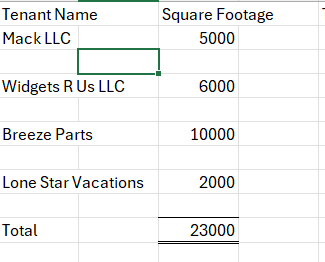
Note: CAM expenses generally cannot be charged to tenants for vacant spaces. The landlord must absorb the vacant space share of costs unless there is a specific gross up clause.
Calculate the Tenant Pro-Rata Share Based on Square Footage
To determine how much of the annual expenses is each tenant’s responsibility, the pro-rata percentage needs to be calculated.
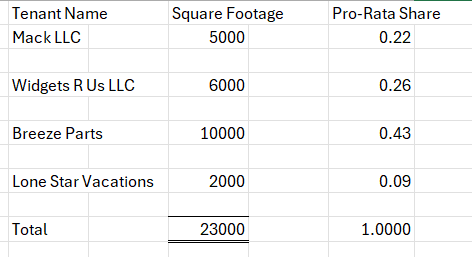
The formula is Pro-rata % = Tenant suite square footage / Total building square footage
Using the information from above, we get the following pro-rata shares
.
Exhibit B
Calculate The Tenant Share of Recoverable Expenses
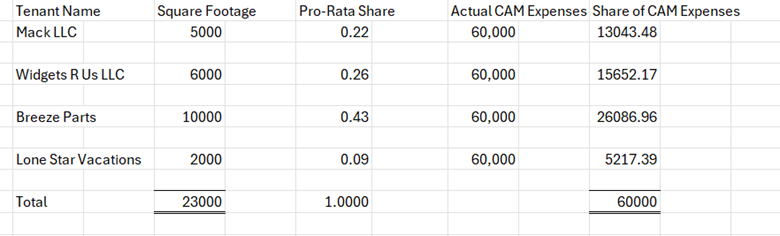
The formula for the tenant share of expenses is Pro-rata share of expenses = Actual CAM Expenses X Pro-Rata Share Percentage. For this example, the total CAM expense are $60,000.00. Each tenant’s share is calculated below in Exhibit C.
The same calculation is required for taxes and insurance. It is important to make sure taxes are correct given the amount of Texas property tax protests and adjustments.
Pro-Rata Share of Taxes = Pro-Rata Percentage X Tax Expense
Pro-Rate Share of Insurance = Pro-Rate Percentage X Insurance Expense
Note: If a tenant did not occupy a suite or space for the full 365 days, the expenses will need to be prorated according to the number of days the tenant occupied the suite.
Calculate the Amount Due From or Credit Due to Each Tenant
The next step is to calculate the amount due from each tenant if the estimated expenses were underbilled. If the expenses were overestimated, the tenant is owed a credit.
Property management software such as Yardi, MRI, or AppFolio have tenant reports to determine how much each tenant was charged per month for CAM, tax, and insurance. If this information is kept in another form, you can still calculate the amount charged. Determine the charges for the past year and deduct the expense for each NNN bucket (CAM, tax, insurance). For example:
Mack LLC was charged $12,000 for the prior year CAM expenses. Their calculated pro-rata share of actual CAM expenses was $13,043.48 per Exhibit C. Mack LLC owes $1,043.48 to the property for the prior year expenses.
Let’s assume Breeze Parts was charged $27,500.00 for prior year expenses. Per Exhibit C above, the tenant overpaid CAM expenses ($26,086.96) for the prior year and is owed a credit of ($1,413.04).
The calculation is repeated for taxes and insurance and the tenant is sent an invoice with an amount due or a credit notice which are applied to the tenant’s ledger.
Need a Bulletproof Simple or Complex CAM Reconciliation?
Don’t let manual calculation errors drain your property’s profitability. At Andris Financial Services, we provide meticulous commercial property accounting, accurate spreadsheet design, and thorough lease reconciliations tailored to Texas property management standards to ensure you recover every single dollar you are owed on your Texas retail or commercial property.
Need help verifying your square footage allocations or reconciling your property’s actual operating expenses? Schedule a consultation below to ensure your CAM calculations are accurate and contract-compliant.